
When the group of children is conscious that they are alone in the island, they start to organise themselves. There are few characters which are more developed by the author. All of them represent a part of the society or the government which Golding depicts through the story. Thus, the author uses their behaviour in order to present his opinion about the current situation of his time.

RALPH: At first sight, he can be considered even the main character of the novel, but in fact, he cannot be without the figures of his companions in the island. Ralf represents many aspects of the British society. On one hand, he is a natural leader and has the charisma that makes the other boys to follow him. On the other hand, he also can be considered as the individual himself who struggles between the correct and the easy way, between what he wants to do and what he has to do.
JACK: He is totally the contrast from Ralph’s figure. Jack represents the bad area of a society. He doesn’t take into account the others’ necessities. He wants to rule the island and he does it violently. Golding uses the figure of Jack to criticize not only the bas area of the British society but also the bad area of the whole world’s society, especially the Nazis and those who support the Fascism during the WWII.
PIGGY and SIMON: Piggy could represent the intellectuals of the time. His death is really symbolical and here we can discover a strong criticism. Golding uses Piggy as the counselor of Ralph. He is the only child who is always conscious of what is happening and whose word is always being silenced by Jack and, in some situations by Ralph, who normally defends him. In fact, it can be said that Piggy represents the element that maintain the group of children civilized since his death is the beginning of the end. Simon, on the other hand is the most spiritual character and through him, the author shows the reader who is the beast. Simon and Piggy are closely related since both of them know what is happening. However, Piggy’s participation on the death of Simon makes him part of the Jack’s group in a crucial moment of the novel, as well as some intellectuals defended the figure of the fascism silencing the voices of other people who tried to tell the truth.

LITTLUNS, BIGGUNS and SAMNERIC: Those three groups (the last one is a couple of twins) represent the mass of population who only follows those in power, with no voice or intention, with no presence in the political issue. However, without these masses a leader, good or bad, cannot exist. So Golding is presenting this group of children as those who contributes to the growth of the “political leaders” of the island.
 The novel presents a group of children who during their evacuation from England because of the Second World War have a plane accident and arrive to a desert island. The only adult that travels with them, dies and they have the possibility of starting again in a new world. This first scene vaguely can remind us that feeling of “never again” that British people had after the First World War, when England had the opportunity of starting again recovering from the fatal disaster that the WWI caused in the country.
The children in Golding’s novel have to create a new society, but the fact that they are children is quite symbolical. Children at Golding’s time were supposed to be pure and innocent, with no symptoms of evil in them. Golding precisely uses the concept of evil in children to depict the way in which a society is carried by the fear of a “beast”, of an evil, to end in a state of destruction as in the end of the novel.
With the frame of the WWII and the situation that the British society was living in during this period, is quite easy to identify the different allegories that Golding uses in order to present this reality.
The Lord of the Flie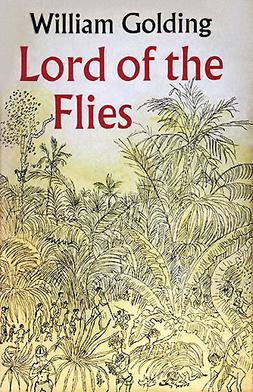 s is a novel written by William Golding published in 1954. It is very interesting to analyse the way in which this author uses this novel as a criticism towards the British government and society after the World War II. Through the book, Golding depicts his own society using a microcosm and placing there a group of children who represent different areas of the society and government. Using their behaviour as well as their condition as children, Golding is able to catch the readers’ attention and made them to think about the real situation that he is describing.
In this paper, we are going to see how the author analyses these different areas and we will try to find out why he does it in this way, taking into account the historical background in which the story was gestated.
Through this analysis, we will discover that, even though at first sight this novel might seem a children’s novel, it is, in fact, a very serious and political weapon against the resulting country England was after the Second World War.
-, NEXT,-
A Midsummer night’s dream: (Visited 01 – 11 – 2010)
– Complete work: http://internetshakespeare.uvic.ca/Library/Texts/MND/Q1/scene/#tln-
– Information about the play: http://internetshakespeare.uvic.ca/Library/SLT/plays/midsummersubj.html
http://en.wikipedia.org/wiki/A_Midsummer_Night%27s_Dream
– Quotations:
Hermia: http://internetshakespeare.uvic.ca/Annex/Texts/MND/Q1/default/#tln-67
Egeus: http://internetshakespeare.uvic.ca/Annex/Texts/MND/Q1/default/#tln-104
Theseus: http://internetshakespeare.uvic.ca/Annex/Texts/MND/Q1/default/#tln-126
– Characters:
Hippolyta: http://en.wikipedia.org/wiki/Hippolyte
Oberon: http://en.wikipedia.org/wiki/Oberon
Titania: http://en.wikipedia.org/wiki/Titania
Elizabethan Era information: (Visited 01 – 11 – 2010)
– Historical background: http://en.wikipedia.org/wiki/Elizabethan_era
– Women in Elizabethan time:
Situation: http://www.elizabethan-era.org.uk/elizabethan-women.htm
Education: http://internetshakespeare.uvic.ca/Library/SLT/ideas/girls.html
http://internetshakespeare.uvic.ca/Library/SLT/ideas/girls+1.html
– Society:
Patriarchal society: http://internetshakespeare.uvic.ca/Library/SLT/ideas/sexes.html
Hierarchy: http://internetshakespeare.uvic.ca/Library/SLT/ideas/sexes.html
Marriage: http://www.william-shakespeare.info/elizabethan-wedding-customs.htm
http://internetshakespeare.uvic.ca/Library/SLT/society/duties.html
References: (Visited 01 – 11 – 2010)
Koci, Katherine; Feminism in a Patriarchal Society: http://uafortsmith.edu/Applause/FeminismInAPatriarchalSociety?skin=text
Elizabethan women: http://www.elizabethi.org/uk/women/
PREVIOUS -.,.- INTRODUCTION
After having read A Midsummer night’s dream and taking into account the background of the time in which the comedy was written, it really surprises us the Shakespeare’s way of presenting both men and women.
The role of men is quite well adapted to the reality since it is the man’s voice which decides and rules everything. However, the fact that a woman’s voice is not only presented but also used as an influential weapon in the comedy makes us to think about the intentions of Shakespeare.
At first sight, this is just a mechanism that the author used to attract the audience’s attention and give the plays its comical sense. Nevertheless, for us, it also means a criticism to the society and the women’s constrains of the time and even a little claim in the favour of women. It is true that during the Elizabethan era, women became a little bit freer. The figure of a powerful queen made the figure of the woman itself a little bit stronger and maybe independent that it had been before. So it is possible that this was what Shakespeare also represented in this comedy: the beginning of a new concept of womanhood which started to wake up through the Elizabethan society.
As we have mentioned before, there is a great parallelism between Theseus and Hippolyta and Oberon and Titania. Both couples represent the highest class in the city and the forest respectively. As the highest class men, Oberon and Theseus represent the political and social authority of their places.
Nevertheless, the atmosphere changes radically from one place to the other and the attitude of the lovers are influenced by that.

In the city, social constrains are stronger and limit a lot women’s personality. They cannot express themselves neither follow their own desires. The patriarchal chain ties them and imprisons women under its rules.
In the forest, a magic place, Hermia, Helena, Demetrius and Lysander are not under the strict social constrains that the city symbolizes. The lovers declare each other with no fear and, although they maintain their chastity, they think about their future freely, without taking into account other people’s opinion. Even although male’s authority is still present in Oberon, the forest represents an idealistic paradise where the young lovers can be happy.