

As we have presented before, the marriage was normally a father’s choice. Consequently, feelings were not taken into account and very few people married for love. Upper classes were nearly condemned to arranged marriages and there were times in which the future wife and husband met each other on the wedding day. When a woman became a wife, she acquired many duties as well as she acquired the status of her husband. That is why in A Midsummer Night’s Dream, Egeus prefers Demetrius over Lysander: he is from a well-known family and this fact would give prestige to his own with Hermia’s marriage. But, in her rebellion against her father, Hermia decides to run away to the forest with her lover, Lysander. This attitude was completely unthinkable for the society of the Elizabethan time and totally reprehensible: a woman who had a pretender needed the family’s agreement in order to continue her romance which normally had to end up in marriage. Hermia disobeys her father and disobeys the law and the chaos becomes more evident.
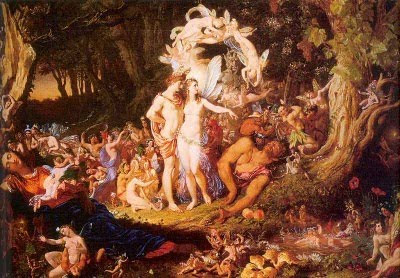
However, the best couple to show how Shakespeare gives voice to women in their relationship with men is the magical one, that formed by Oberon, king of the fairies and Titania, the queen of the fairies. Both of them are powerful in the forest and, in fact, their argument is the element that mixes all the stories up. Titania’s position against Oberon is quite brave. She doesn’t want to satisfy her husband and she doesn’t mind the consequences her behavior can have over her or the others. Oberon as a husband but also as a king wants to maintain his authority and tries to punish Titania for her attitude. We cannot forget that she, as a wife, has several duties as well as an established pattern of submissive behavior towards her husband. So, although she is a queen, she is not powerful enough since her husband is still over her. We can find a parallelism between these characters and Theseus and Hippolyta: even both women are strong and powerful, they are not able to rule themselves.
In Elizabethan times, when a woman disobeys her family, could be sent in front of law. Women’s rebellion was not accepted by the patriarchal society and, in case of it, women were punished for breaking the law.
In A Midsummer Night’s Dream, Egeus decides to bring his daughter in front of the authority of the place, the Duke Theseus. He listens what Egeus, Hermia and both Lysander and Demetrius say about the conflict. Obviously, he shows his preference for Egeus’s opinion and advices Hermia to follow his father desire. If not, she would have to accept the death penalty.
[…]
For you, faire Hermia, looke you arme your selfe,
To fit your fancies, to your fathers will;
Or else, the Law of Athens yeelds you vp
(Which by no meanes we may extenuate)
To death, or to a vowe of single life.
Here, Shakespeare is showing us the reality: how male figures  apply the whole society rules over women, making them voiceless against society. Women were tied to men’s desires in familiar issues as well as in political issues.
A similar situation is presented in the couple of Theseus and Hippolyta. She represents the way in which a woman was expected to behave because she has permitted the supremacy of Theseus over her. What emphasises the “kind” behaviour of Hippolyta now is the fact that she had been the Queen of the Amazons. In the moment Theseus captures her, she surrenders to him in all the aspects, forgetting about her former authority as a queen. However, she has a crucial role in the play, when in Act V, defends the story of the four lovers and influences in the final decision of Theseus.
 Although this comedy is settled in Athens, the patriarchal society’s rules were the same that those which were established in England. So, at that time, a father decided in advance who would be the future husband of his daughter and she had to obey her father’s desire. This was a way of ensuring the family’s continuity as well as the economic situation since the lack of a heir supposed nearly a disgrace for a family.
Shakespeare presents this situation as the frame of A Midsummer Night’s Dream’s main plot: Egeus, Hermia’s father, has decided that she is going to get married with Demetrius. He has decided that without taking into account the fact that his daughter is in love with Lysander.
In a real situation, Hermia would have not the possibility of argue with her father because of his decision. She would have to accept it whether she liked it or not. But what William Shakespeare does in this play is presenting the alternative to this submissive behavior: Hermia defends her love for Lysander and strongly refuses to obey her father in front of Theseus:
I doe intreat your grace, to pardon mee.
I know not by what power, I am made bould;
Nor how it may concerne my modesty,
In such a presence, here to plead my thoughts:
But I beseech your Grace, that I may knowe
The worst that may befall mee in this case,
If I refuse to wed Demetrius.
This really surprises the audience and provokes the chaos with which every Shakespeare comedy begins. The relationship between Egeus and his daughter, who is considered as a property, is shocked by the rebellion of Hermia since she challenges her father, and the man claims for his power over her:
Scornefull Lysander, true, he hath my loue:
And what is mine, my loue shall render him.
And she is mine, and all my right of her
I doe estate vnto Demetrius.
At this point, she is breaking the rules and, in some way, she is behaving as a traitor for her father. That is why Egeus decides to present the situation he is living with his rebel daughter to the Duke of Athens, the political authority.
The life was quite different during the Elizabethan era for men and women. Both genres were strictly scheduled by social roles. The Elizabethan woman was absolutely subordinated to a male figure (father, husband, brother…) and she had to obey and satisfy him.

Education for women was quite limited, but it also depended on the social class they belonged to: high-class women were a little bit freer in this area than lower-class ones, and although they were subordinated to men too, these upper class women could have access to a kind of education that poor women could not ever dream of. However, girls could not go to University, as men could do, so they had very few choices if they studied and didn’t marry.
The figure of men was also quite stereotyped since they had to be the protector and guide for women. They decided everything and, in fact, men ruled society and government since women were politically voiceless.
In A Midsummer Night’s Dream, there is a contrast with the reality of the time in which it was written. We obviously can see how women are subordinated to men from the very beginning with the “forced” compromise between Theseus and Hyppolyta, but we also discover how women (Hermia and Titania) try to challenge these men’s rules and rebel against them. We are going to see both, men’s and women’s behavior, in some different kind of relationships. This situation presented by Shakespeare actually breaks with the order that religion and society had established referring to the different sexes.

In this paper we are going to analyse the relationship among men and women through A Midsummer Night’s Dream, written by William Shakespeare around 1595. Taking into account the historical background in which the story is settled, we are going to extract many conclusions about the way men and women behave publicly and privately. However, as it is shown afterwards, we can find many contradictions between the reality of the social men and women relationship and the way Shakespeare presented it in this comedy. Here, we are presented a love story full of magical allegories, confusions and rivalries not only amongst the different lovers and pretenders but also amongst men and women at different levels.
In general terms, the social hierarchy and the superiority of men over women are loyal to the Elizabethan background and these facts are settled as the frame for the whole story. Nevertheless, is the rebellious behaviour of women what changes the plot and forces the different situations in which men and women are implied. We have to take into account that it is probably a Shakespeare’s technique in the creation of the comedy, but for us, it is an interesting way of giving voice to the voiceless women of that time, even though, at the end of the story, is the word of a man (the Duke) which decides everything.
-. NEXT .-