
 In the following paper, we are going to analyze the characteristics of William Shakespeare’s comedies and, particularly, the way in which the author presents men and women as well as the relationship among them. For this purpose, we are going to use as example three different comedies: A Midsummer Night’s Dream , Twelfth Night and The Taming of the Shrew. In the three plays, we can see how Shakespeare presents us men and women following, in general terms, the stereotypes of the Elizabethan era, the historical background in which they were conceived. But he went a little bit further since many of the situations that we are shown wouldn’t be accepted by the patriarchal society of the time.
So, in these three works, we can find different characters with similar behaviors: rebel women as Titania, Olivia or Katherina, who try to be independent and decide about their own destiny; and authoritative men, as Oberon, Orsino or Petruchio, who try to control the women (daughters, lovers, wives…) that surround them.
Taking this into account, what we are going to examine is how the relationship between men and women was depicted by Shakespeare’s hand and how the author seems to give another perspective to the stereotyped image of submission that women had in his time.
 William Golding was a brilliant British author who wrote a great amount of novels. His most famous work is The lord of the flies, but he wrote many other great fiction novels which deserve to be read and analysed. In many of them we can clearly see how Golding is depicting many aspects of the social and political reality of his time. He used his literature to show what he understood about the time he was living. His own experiences and ideas are exposed and they influenced in a subtle way all his writings. Our purpose in this paper is to show these elements among the different novels of the writer.
Thus, we are going to work on The Inheritors, Pincher Martin: The Two Deaths of Christopher Martin, Free Fall, The Spire, Darkness Visible and, of course, on the already mentioned The lord of the flies. Golding also wrote other fictional and non fictional novels as well as some essays, but what we want to show is how he used the literature as a critical weapon against the reality in which he lived. He disguised reality in different situations in order to present the readers a general idea: there is nothing as simple as it seems.
-.NEXT.–
The Lord of the Flies:
– Complete work: http://www.zbths.org/165310818145034323/lib/165310818145034323/_files/LOTF.pdf
– Information: http://en.wikipedia.org/wiki/Lord_of_the_Flies
– Quotation: http://www.zbths.org/165310818145034323/lib/165310818145034323/_files/LOTF.pdf
William Golding:
– Information: http://en.wikipedia.org/wiki/William_Golding
– Web page: http://www.william-golding.co.uk/
Historical background:
– Second World War: http://en.wikipedia.org/wiki/World_War_II
– Democracy: http://en.wikipedia.org/wiki/Democracy
– Fascism: http://en.wikipedia.org/wiki/Fascism
References:
– Amal Gedleh, William Golding Symbolism in Lord of the flies; M.U.A. High, Scarborough, Ontario. January 2009: http://www.literature-study-online.com/essays/golding-lord-of-the-flies.html
– Frost’s Meditations: The Lord of the Flies http://www.martinfrost.ws/htmlfiles/april2007/lord_flies.html
PREVIOUS -.,.- INTRODUCTION
After reading a book like The Lord of the Flies it is quite evident the influence that the political and historical facts have in the literature. But it is also quite evident the use of this literature as a way of criticism.
William Golding wrote this book making a great depiction of the world that surrounds him in the 1950s. The influence of the War, the figures of the Fascism, the poverty and devastation as well as the repression and the censure are quite present in his novel. When I firstly read the novel, I really enjoyed it in the psychological aspect, but in a second reading, and using the historical background as the frame of the story it was even more complete and fascinating. Golding transmits in a very subtle way his opinion of the situation of the time and presents the reality in an impacting disguise that shows the cruelty of the world in those years.
“Other boys were appearing now, tiny tots some of them, brown, with the distended bellies of small savages. One of them came close to the officer and looked up.
“I’m, I’m—”
But there was no more to come. Percival Wemys Madison sought in his head for an incantation that had faded clean away.”
(Chapter 9, The Lord of the Flies)
 This part of the book, the end, is very symbolical if we take into account the situation of England at the end of the WWII. The loss of the Empire and the devastation of the country were really difficult situations for the society of the UK. As Percival, there was one time in which British people could be proud of what they were and what they represent, but after the War, they were economically and psychologically destroyed. The questions of identity as well as the nationalism are concepts that got importance during that period.
Golding’s criticism to those in power is quite evident if we take into account the figures of Ralph and Jack. Both of them represent the leaders of the both separated groups in the island.
While Ralph with Piggy at his side and the white and rose conch as his symbol represents the democracy, Jack, with Roger and the knife clearly represent the figure of Hitler in the fascism.
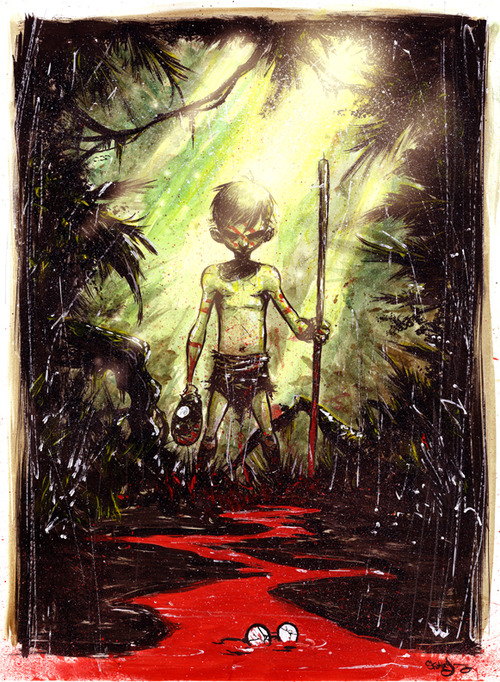 In fact, it is the intention of Jack for being the leader of the whole group of children which evolves in a battle for the control of the island. Furthermore, the murders of Simon and Piggy make more evident the parallelism between the character of Jack and the figure of Hitler. When both Simon and Piggy disappear, Ralph, or the democracy, is in fact extremely in danger and everybody in the island wants to kill it. The children are capable to destroy their environment in order to murder Ralph, just because he is the only “thing” that is different from them. Jack, with Roger’s help, is able to convince all the children to do what he wants, but using the fear and the knife as his weapons. Thus, his cruelty is shown from the very first moment in which he wants to kill the sow. He is not voted as a leader as Ralph is. He is imposing himself little by little, manipulating the children’s mind using their fear and his promises of fun and “fresh meat”. It clearly reminds us who figures like Hitler became powerful in Germany.
Nevertheless, another interpretation can be extracted from the text since the fact of not having a strong government evolves into a situation of chaos or, in other terms, of anarchy. At the beginning of the story, when Ralph asks the children to get some food and wood, they prefer to play and no order is established at all. This situation actually provokes the following chaos, characterised by the savagery and the presence of the “beast”, the abstract concept that uses Golding to show the reader that what makes wars is the human being itself.